The Rat People- How to Start a Cult in Singapore (2026)
Sniff, sniff. The burn is back. Southwest monsoon. Mid-August, right on schedule. Feral Indonesia blowing Gudang Garam breath straight into the faces of the soft, overbred Singapore boys and girls. Then the smell of cooked food cut through it. I followed it like an animal. Umbrella pointed out in front of me like a dowsing rod, angling south. Block 19, Marsiling Lane. The bench boys were nearby. Scrawny, watchful, all elbows and cheekbones, staring at passersby with those crazed eyes. Marsiling in its usual condition: dingy, depleted, poor.
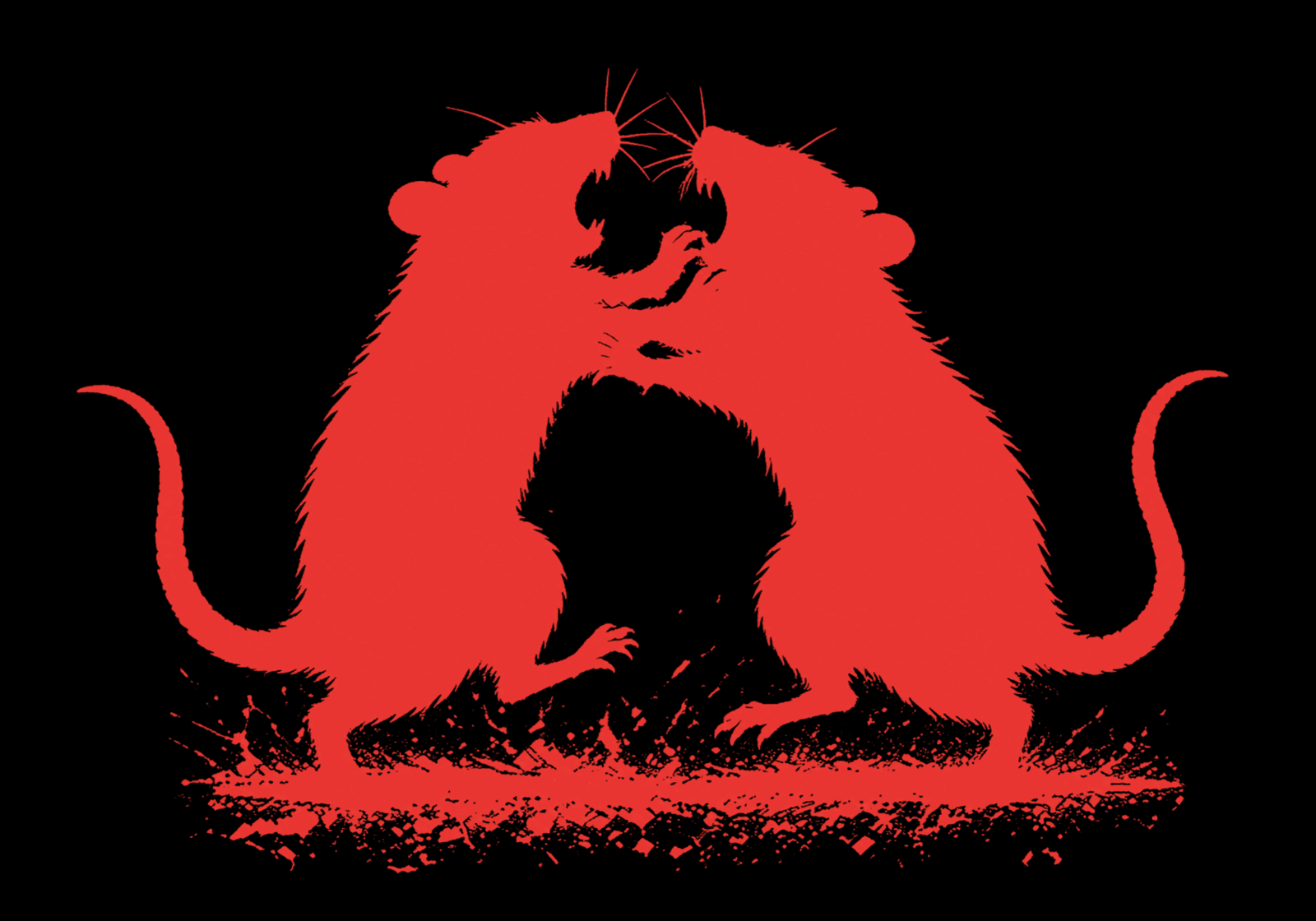
Thunder. I looked up. Humid night. The sky had sealed over. Low, overcast, filthy. Marsiling-Kranji is a lightning hotspot. Bad strip for it. I kept the umbrella up like cover, moving through the estate under it like undercover. They might be watching me from somewhere above. Watching, measuring and waiting to send lightning down on my head. Better move quick. I moved in through the back, as I always did. The rats were unmoved by thunder, just gnawing on.
Then there was movement near the rubbish point: two figures by the bins. Up to something. Maybe at it. I moved closer and saw a long-haired Mat and a bapok. I put my fingers in my mouth, whistled hard, then pointed the umbrella at them like some night watchman. “Oi! Sio gan ah?” Then I gave them a series of dirty little hand gestures.
“Kau sial lah,” answered the Malay guy. “You think we like that, meh?” said the trans woman in loud, shrill voice, making a lewd sucking mime before pointing at the packets of zhap cai peng. The food had been extra portions meant to be given away, but had since been left there for disposal. They were scavenging what they could to bring back.
Leather-skinned ah peks on Guinness Stout, talking Vietnamese girls. Gold-haired bookies with Siamese tattoo working through peppered pig offal and ribs in soup. Night workers folding up the last of their roti prata supper. We sat down with a packet of food each. I played the generous one, bought us all teh tarik kurang manis.
My new friends were the odd Marsiling specimens. The long-haired Malay I called Slayer. Mid-fifties, with stoned eyes and sunken cheeks. He wore that Root of All Evil t-shirt with the green demon. The only other shirt he claimed to own was his Grab uniform. Camo pants below. Slippers. Operation Desert Storm, he said, battle-ready. He did rollies and smoked. His prized possession was a Yamaha Sniper 155, though he said he once owned an MBX and gone to war against LC gangs.
The trans woman went by Adeline. Maybe early fifties. Tall, long curls, high cheekbones, and glaring eyes that made her look like a strung-out old club queen who’d seen too many bad nights. More beard shadow than Slayer on a Monday morning. Adeline insisted that I address her as she. Wore skimpy black dress, high heels, Elle shoulder bag. Pure ‘80s-90s throwback. Claimed the dick was still there for commercial reasons. Coarse and deep voice when serious, shrill when worked up. Usually worked up. She smoked Virginia Slims with finesse.
Enter the Dragon- Notes from a Chinese Singaporean (2025)
I remember attending a gala dinner in Bangkok in 2017, hosted by a Chinese biotech company that billed it as a “collaborative” Asia-Pacific event, with representatives from across the region, some even from as far as Germany. But I almost thought I’d walked into the wrong venue, because the whole setup looked surreal; like a CCP jubilee, complete with Maotai (a strong Chinese liquor) and “Western entertainment” in the form of fashion shows with models in lab coats strutting to the techno beat of a Chinese song about “little apple.” It was, mind you, during the height of Beijing’s Belt and Road Initiatives with the “Land of a Thousand Smiles,” evident when the over-smiling Thai hotel staff spoke to guests in Mandarin.[i]
Then, in a moment that no one had quite prepared for, the emcee, who had been narrating the evening, suddenly broke into two seemingly patriotic numbers, one being “Descendants of the Dragon” (龍的傳人; lóng de chuánrén), which left many members of the (non-China) audience dropped their jaws, by the display of zealous gusto from the emcee/organiser.
Though for me, it wasn’t so much of that awkwardness that burst forth (I figure that the dinner was attended by some important officials), but the exquisite irony on the choice of that song. Perhaps it wasn’t widely known, but that blood-red anthem about the dragon-lineage of Chinese people was actually a protest-song composed in 1978 in Taiwan by Hou Dejian (侯德健), written specifically against the United States’ diplomatic recognition of the People’s Republic of China (PRC).[ii] This was widely misused as part of PRC propaganda, because it was later released as a folk-pop song in the ‘80s, sung by Taiwanese artist Lee Chien-Fu, whose version was misinterpreted as a pan-Chinese call for unification, and it grew immensely popular in China.[iii]
This appropriation grew to a larger phenomenon, when many Chinese all over the world started to refer themselves as the “Descendants of the Dragon,” conflating the song, the strictly imperial totem, and pop culture (“Enter the Dragon,” a film with Bruce Lee) into a hyperreal association. Historically, the Chinese referred to themselves as “Descendants of the Yan and Yellow Emperors” (炎黃子孫), more so than the dragon, which until recently, was emblematic for emperors.[iv]
Nevertheless, the choice of this mythical creature went beyond its role as a unifying symbol in the Chinese imagination; beneath the political awkwardness, it reveals far more about Chinese history itself.
[i]. Yu, C., Zhang, R., An, L., & Yu, Z. (2020). Has China’s Belt and Road Initiative intensified bilateral trade links between China and the involved countries? Sustainability, 12(17), 6747. Retrieved from https://doi.org/10.3390/su12176747
[ii]. Bohlman, P. V. (Ed.). (2013). The Cambridge history of world music. Cambridge University Press.
[iii]. Chow, Y. F., & de Kloet, J. (2012). Sonic multiplicities: Hong Kong pop and the global circulation of sound and image. Intellect.
[iv]. Zhang, D. C., & Cziráková, D. (2023). Descendants of the dragon: The dragon as a symbol of Chinese national identity. Asian and African Studies, 32(1), 60–82. Retrieved from https://doi.org/10.31577/aassav.2023.32.1.04
Boomer Work Ethics & Its Lasting Influence- Not OK, Boomer (2025)
Fresh out of Northwestern’s Kellogg School of Management in 1976, Doug Conant landed his first job at General Mills, cutting his teeth in marketing and product management.[i] Over the next decade, he climbed the corporate ladder, honing his skills in marketing and strategy before making the jump to Kraft. There, he continued in leadership roles before taking the reins as President of Nabisco Foods Company in 1995. Under his watch, Nabisco saw five straight years of double-digit earnings growth. By 2001, after roughly 25 years of steady ascent, Conant was appointed President and CEO of Campbell Soup Company, where he led a successful turnaround, improving both financial performance and employee engagement before retiring in 2011.[ii]
That kind of career arc is what Boomers attest and aspire to, complete with music from Percy Faith playing in the background (or in the elevator), and the scenes of a nicely suited young man, saying “good morning” to smiling colleagues in the office of a reputable company, putting in consistent hard work like a respectable person of society, and one day they pay off into a solid pension, a good status and quite a comfortable life, cue the same type of music playing again in the background, though more yacht-themed this time. This scene from the Boomer’s head exudes the mantra of “study, get a job, put in hard work, work your way up,” which has proven to be the reliable formula that most of them followed, that worked exceptionally well for its time.
The formula worked not entirely because of the reliability of hard work and effort, but because the postwar environment was nurturing; a world of cheap energy, booming markets, and companies that behaved more like cautious caretakers than the predators they later became. Back then, you could almost plot a career with a ruler and a sheet of graph paper: put in your years with diligence at companies built to last, and you get rewarded accordingly.
That world, however, is gone. Today’s version of modern-day slavery increasingly resembles the darker nature of its past, where exploitation and callousness rear their heads without the need for Boomer formalities. What had been the path to career-building now leads back obviously to the jungle.
What remains is a kind of theatre. We still enact the rituals, keeping up with appearances, though the payoff is no longer what it once was. The work ethic and diligence no longer guarantee the same kind of reciprocity from the employers, who themselves are feeling the brunt of an unforgiving economy. The soundtrack, too, has altered. Where once there was unremarkable but reassuring muzak, now it is the monotone of earnings calls, followed only by the quiet that settles in after another round of redundancies.
[i]. Conant, D. (2011). TouchPoints: Creating powerful leadership connections in the smallest of moments. Jossey-Bass.
[ii]. Encyclopedia.com. (n.d.). Conant, Douglas R. Retrieved from Encyclopedia.com